The majority of plan-related activity happens in the prefrontal cortex (PFC) of the brain,1 and in the mid-doroslateral prefrontal cortex (mid-dlPFC) in particular.2 However, since planning utilizes so many different cognitive processes and with such diverse information, planning-related brain activity is not constrained to that area.
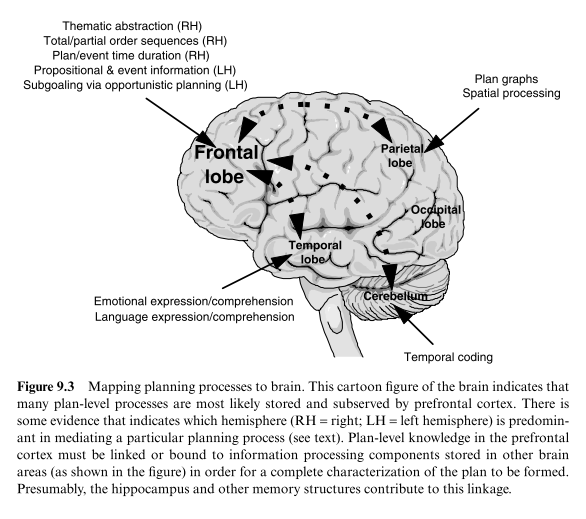
The neurotransmitter dopamine is also notably involved in planning. It “plays a major role in the activation (stability) of goal representations,” and “has been associated with intrinsic motivation and response readiness.”3
Sources:
- 1.Grafman J, Hendler J. Planning and the brain. Behav Brain Sci. December 1991:563-564. doi:10.1017/s0140525x00071351
- 2.Heinze K, Ruh N, Nitschke K, et al. Transcranial direct current stimulation over left and right DLPFC: Lateralized effects on planning performance and related eye movements. Biological Psychology. October 2014:130-140. doi:10.1016/j.biopsycho.2014.07.019
- 3.van der Linden D, Frese M, Meijman TF. Mental fatigue and the control of cognitive processes: effects on perseveration and planning. Acta Psychologica. May 2003:45-65. doi:10.1016/s0001-6918(02)00150-6